Wednesday, December 29, 2021

APOE gene is related to Alzheimer's disease, but also to Covid-19 vulnerability

 I made APOE gene statistics using the 1000 genomes data.  The APOE gene is bound to two SNPs, rs429358 and rs7412, both on the chr 19.  In the worst case both are homozygous for the allele C (e4  resulting vulnerability of 12x for late-onset Alzheimer's and 61x for early-onset disease.  If the first SNP is heterozygous and the latter CC (e3) the possbility is still >3x increased risk for Alzheimer's; 1.4x increased risk for heart disease.  Now, new studies connect these alleles also to increased risk for serious Covid disease.

Study


rs429358 freq/individual, rs7412 any value LWK 0.727 GWD 0.478 ESN 0.465 MSL 0.447 ACB 0.417 YRI. 0.389 FIN 0.364 ASW 0.344 CEU 0.333 GBR 0.330 CLM 0.277 STU 0.255 IBS 0.243 PUR 0.212 TSI 0.187 CHB 0.184 CDX 0.183 BEB 0.174 MXL 0.172 ITU 0.167 PJL 0.167 JPT 0.163 KHV 0.121 PEL 0.118 CHS 0.105 GIH 0.097 APOE4 FREQ/ind, rs7412=CC LWK 0.1515 GWD 0.0796 ACB 0.0729 ESN 0.0606 MSL 0.0588 GBR 0.0440 FIN 0.0404 YRI. 0.0370 ASW 0.0328 CLM 0.0213 CEU 0.0202 KHV 0.0202 STU 0.0196 JPT 0.0192 BEB 0.0116 PJL 0.0104 GIH 0.0097 IBS 0.0093 APOE3 FREQ/ind, rs7412=CC LWK 0.424 ESN 0.343 MSL 0.329 GWD 0.319 YRI 0.315 CEU 0.293 FIN 0.283 ASW 0.279 ACB 0.271 GBR 0.242 CLM 0.234 IBS 0.224 STU 0.216 PUR 0.212 TSI 0.187 CHB 0.184 CDX 0.183 MXL 0.172 ITU 0.167 BEB 0.151 PJL 0.146 JPT 0.125 PEL 0.118 CHS 0.105 KHV 0.081 GIH 0.078

Monday, October 18, 2021

European IBD statistics

 Many online genetic services provide individual  ancestry results but don't reveal their methods.  For me 9 of 10 services give Finnish plus minor 5-8% admixture of Greek or Italian.  I have seen a man of fully Croat ancestry getting additionally 12 % Orcadian ancestry.  Surprising Orcadian in Balkans, really? Only to mention two examples. Those ancestry testing companies looks like modern alchemists.  My advice is, don't pay, you can get ancestry tests for free from services using open source softwares.   Maybe results of open source softwares are not perfect, but at least you have a possibility to find out how the results are done. 

It is obvious that these companies use a special data adaptation and model putative ancestral pools to geographical locations according their own approaches, but they are not professional historians.  Maybe there is seen a growing genealogical demand in countries where the paper trail is incomplete or they simply try to give a shortcut bypassing paper trail, but according my experience there is no substitute for the old fashion genealogy work.  I am not going to start searching my Italian cousins, because  my paper trail, fully covering to the end of the 17th century, doesn't show Italian roots. 


Sunday, September 19, 2021

A new Finnish study about yDna haplogroups

 A new study observes yDna haplogroup frequencies and CAD (Coronary artery disease), in Finnish sepelvaltimotauti) vulnerability of haplogoups in Finland.  Haplogroup frequencies show very close same number with the study Lappalainen et al. 2006, but differ from the study Neuvonen et al. 2015.  New haplogroup proportions are


N1c1 60,18 %
I1 26,44 %
R1a1 5,99 %
R1b 5,01 %
I2 0,97 %
E1b1 0,51 %

The study is dowloadable from the link in the end of the following textlink

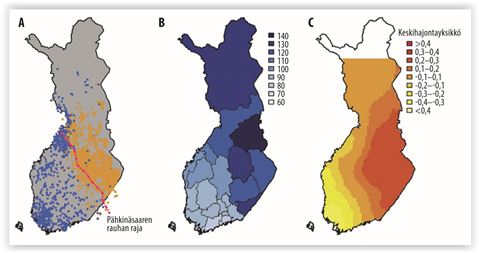
Results figuring CAD are contradictory with another Finnish study.  This study (published in a Finnish medical magazin Duodecim by Joel Nuotio*, Tomi T. Laitinen* ja Markus Juonala, Link) gives following results, showing the highest vulnerability of CAD in East Finnish regions where the proportion of N1c1 is highest and the lowest vulnerability was found in Southwest regions where the N1c1 proportion is the second highest.  

Picture:


A - autosomal genetic structure in Finland

B - CAD incidence

C - genomewide CAD risk


I see two main factors involved with the disease vulnerability

- way of life

- autosomal inheritance


The Duodecim article shows the highest CAD incidence in the northeast and lowest in the southwest, both areas having the highest N1c1 proportions in Finland.  The way of life is today quite the same everywhere in Finland, thanks to the similar food markets and consistent culture  in the whole  country.  So what remains is differences in the autosomal inheritance.  Southwest and east have been isolated from each other hundreds years in the Finnish history and we can predict also significant difference in the autosomal inheritance of those two areas, the difference we can also see using autosomal genome tests.  Basically the areas of the HG I1 are between southwestern and eastern N1c1 areas and we can predict that the CAD vulnerability of I1 should be between the vulnerability of those two N1c1 areas. 


Tuesday, September 14, 2021

Patterns of genetic connectedness between modern and medieval Estonians and Finns

 A new Estonian study sets the connection between our countries to the 8th and 10th centuries AD and bases it on an assumed Estonian migration to Finland.  Sounds like Estonian self-seeking idea about  Estonian Vikings.  Heard before.  I have not knowledge about such Estonian migration.

  There have been a lot connections between our countries, but historians have never mentioned exactly aforementioned time frame as a significant event in our history.  Sure people have moved from Estonia to Finland, but also conversely.  Historians suggest that the main migration bringing the Baltic Finnic language happened during the Roman Iron Age and we know for sure that around 20-30% of the North Estonian population had Finnish origin after the Swedish era in the 17th century.  We know it because we have original documents.  Those times were very exhausting in Estonia due to many wars and the Estonian population size decreased remarkably.  

Such a Late Iron Age migration from Estonia should also be seen by an elevated R1a proportion in Finland, but the small R1a amount in Finland doesn't imply any Estonian origin.  I stay waiting for wider scientific stance.

Link


The grave of Viking female revealed many surprises

 It was long assumed that the grave was made for a woman, for a Viking queen or princess. Archaeological evidences spoke about a female, clothes and jewellery were typical for a female, but the luxurious sword gave a hint about a male.  The sword was so fine and luxurious that it has been a model for replicas sold under the topic "Sword of Suontaka Viking princess".  But genetic analyses  revealed that the buried one was not a typical man or woman, the remains showed signs of both, namely a chromosomal XXY structure.

Link


Monday, September 13, 2021

The dichotomy between Eurasian and African X chromosomal haplotypes

I made a statistics showing a full bifurcation between East-Asia and Africa. Showing high similarity in the whole Eurasia it is likely that the Eurasian haplotype is related to the OOA event. To see how much the African haplotype in Europe represents Near East migrations needs more investigation. The result implies however that not all and there have been different evolution and migration routes in Eurasia. The haplotype includes 15 SNPs.

Percentages of East Asian (pure African type is 100 - x)

Han Chinese 100
Southern Han Chinese 100
Japanese 100
Kinh Vietnamese 99.494949
Dai Chinese 98.92473
Punjabi 96.07639
Peruvian 94.70588
Bengali 92.48062
Sri Lankan 91.04575
Gujarati 90.64725
Mexican-American 89.8958
Indian 88.7255
CEPH (Utah Euro) 87.2727
Finnish 83.4007
Tuscan 82.0561
Colombian 81.5603
Spanish 80.9034
British 79.8535
Puerto Rican 70.1603
African-American SW USA 23.5519
African-Caribbean 8.1597
Luhya 7.71040000000001
Mende in Sierra Leone 3.098
Gambian 1.5044
Yoruba 0.987700000000004
Esan 0.808099999999996


Monday, August 30, 2021

Lost Finnish study

 I found newly some information about once lost Finnish study on the Eupedia forum, but still the source unknown.  If you know where is this data from, please inform me, I appreciate it.  I assume that the study can be published during this autumn, but can't be sure.   I suppose it has been on the agenda of the deleted symposium EAA2020.


This is interesting especially because of the certain illogicality between released yDna and autosomal data.


https://www.eupedia.com/forum/threads/40385-The-12th-century-communities-illuminates-the-genetic-makeup-in-the-southwest-finlandh


"The 12th century communities illuminates the genetic makeup in the southwest finland

Abstract author(s): Saari, Nelli-Johanna (University of Helsinki, Department of Philosophy, History, Culture and Art Studies; Max
Planck Institute for the Science of Human History, Department of Archaeogenetics; University of Helsinki, Faculty of Biological
and Environmental Sciences, Organismal and Evolutionary Biology Research Programme) - Majander, Kerttu (Institute of Evolutionary Medicine,
University of Zurich; Max Planck Institute for the Science of Human History, Department of Archaeogenetics)
- Salmela, Elina (University of Helsinki, Faculty of Biological and Environmental Sciences, Organismal and Evolutionary Biology
Research Programme; Max Planck Institute for the Science of Human History, Department of Archaeogenetics; University of
Turku, Department of Biology) - Krause, Johannes (Max Planck Institute for the Science of Human History, Department of Archaeogenetics) -
Onkamo, Päivi (University of Helsinki, Faculty of Biological and Environmental Sciences, Organismal and Evolutionary
Biology Research Programme; University of Turku, Department of Biology)

Abstract format: Poster

Southwest Finland has rich Late Iron Age archaeological records that show diverse cultural and trade networks. Ancient DNA analyses
from human remains, however, have remained scarce due to the acidic Finnish soil that leads to a rapid decay of bone material.
Two large inhumation burial grounds from the Crusade Period (1050–1150 CE) in Southwest Finland, Raisio Kansakoulunmäki and
Masku Humikkala, represent the transition period towards Christianity. The favourable skeletal preservation on these sites offers a
possibility to analyse the genetic structure of the Iron Age communities behind the burial context. Combining this genetic data to
other periodically and regionally close individuals enables an in-depth examination of the population history of Late Iron Age Southwest Finland.
In this archaeogenetic study we investigate the genetic composition of altogether 29 individuals, 14 from Kansakoulunmäki and
15 from Humikkala. A closer analysis of kinship patterns and genetic ancestry provides comprehensive information of the Late
Iron Age communities, such as family relations and patrilocality. All samples in this study have been processed in dedicated cleanroom facilities.
Ancient DNA libraries have been enriched for ancestry-informative markers in human DNA, and the data retrieved
with high-throughput next-generation sequencing. The preliminary results for seven Raisio Kansakoulunmäki individuals indicate a
genetic continuity with contemporary Finnish populations. Our current analyses intend to provide a detailed view of the ancestry
components, kinship and genetic affinities for all successful samples.


SOURCE:

https://eaa.klinkhamergroup.com/eaa2020/full_paper/files/2647/NJS_EAA2020_poster_updated_final_pdf.pdf


Sample ID Sample Individual information Called SNPs Burial Osteological Genetic MT hg Y hg Radiocarbon age (BP)
RK2002 Petrous part Mature adult (35-64) 260.771 F F? F H5b2 NA 828±27 BP
RK2003 Petrous part Young adult (18-44) 166.090 NA NA F H27a NA 937±28 BP
RK2004 Petrous part Infant (2-3 years) 354.779 NA NA F H3h1 NA 988±28 BP
RK2006 Petrous part Juvenile (9-11) 114.529 NA F F H27a NA 950±28 BP
RK2007 Petrous part Mature adult (35-64) 16.998 F F? F NA NA 995±24 BP"


RK2009 Petrous part Young adult (18-44) 385.637 F M? F U5b1 NA 924±28 BP
RK3005 Petrous part Juvenile (12 years) 205.527 NA F? M T1a1 N1a1a1a1a 772±28 BP
RKA001 Petrous part Young adult (18-44) 102.282 NA M? M A12a N1a1a1a1a 871±30 BP